


Nails That Break Easily? The Real Reasons and How to Strengthen Them
A makeup artist friend once held up her hands backstage, laughing as one fingernail snapped clean off while she reached for a brush. “I swear,” she said, “my nails have a personal vendetta.” It was funny, yes, but also familiar. Brittle nails, peeling nails, nails that split the moment they grow past the fingertip—this is one of the most common nail problems people quietly deal with.
If your nails that break easily feel like a mystery, you’re not alone. In most cases, the explanation is less dramatic than we fear and more practical than we expect. Nail health reflects daily habits, skin health, and what’s happening beneath the nail surface, all working together in subtle ways.
What Your Nails Are Telling You About Your Overall Skin Health
Your nail is skin’s quieter cousin. The nail plate is made primarily of keratin, the same protein found in hair and the outer layer of skin. When nail strength falters, it often hints at an imbalance rather than sudden damage.
Weak nails, nail splitting, and nail fragility usually show up when moisture levels are off. A healthy nail plate bends slightly before it breaks. Dry nails snap. Dermatologists often notice that brittle nails arrive alongside dry skin, irritated cuticles, or changes around the nail bed.
Nail changes can also reflect internal shifts. Healthy nails tend to grow evenly from the nail matrix. When growth slows or becomes uneven, it’s worth paying attention, gently, without panic.
Everyday Habits That Quietly Weaken Nails
One of the biggest culprits behind fragile nails is water. Frequent hand washing, hand sanitizer, and repeated soaking swell the nail structure, then dry it out again. Over time, this expansion and contraction weakens nail thickness.
Household cleaners add another layer of stress. Many contain solvents that strip oils from the nail surface and cuticle. Without rubber gloves, nails absorb that exposure directly.
Then there’s grooming. Nail biting, picking at peeling, or aggressive manicures can damage the natural nail. Over-filing, especially with coarse grit, creates micro-tears that invite nail splitting.
The Role of Nail Care Products: Helpful or Harmful?
Nail polish can be protective or problematic, depending on how it’s used. Constant polish wear without breaks may dehydrate the nail plate, particularly with long-wear systems like a gel manicure or acrylic nails.
Nail polish remover plays a role too. Acetone removes color quickly, though it also pulls moisture from the nail. Non-acetone versions are gentler but still drying with frequent use.
Nail hardener sounds like the answer to weakened nails, yet many formulas increase rigidity without flexibility. That combination can lead to snapping. Breathable nail products can help to some degree, though nails do not truly breathe. Sometimes bare nails and a simpler manicure routine allow damaged nails to recover.
Nutrition, Hydration, and Nails That Bend or Break
Nail growth depends on consistent nutrition. Protein supports keratin production, while iron deficiency is a well-known cause of nail brittleness. Biotin and zinc also contribute to nail structure.
Dehydration shows up clearly in fingernails. When the body runs low on water, nails lose their natural resilience. Supplements may help in certain cases, though they are rarely a quick fix.
Sudden nail changes, deep ridges, or persistent brittleness can signal a reason to speak with a healthcare provider. Occasionally, nail fungus or underlying health shifts affect the nail bed and matrix.
Skincare for Hands and Nails: The Missing Step
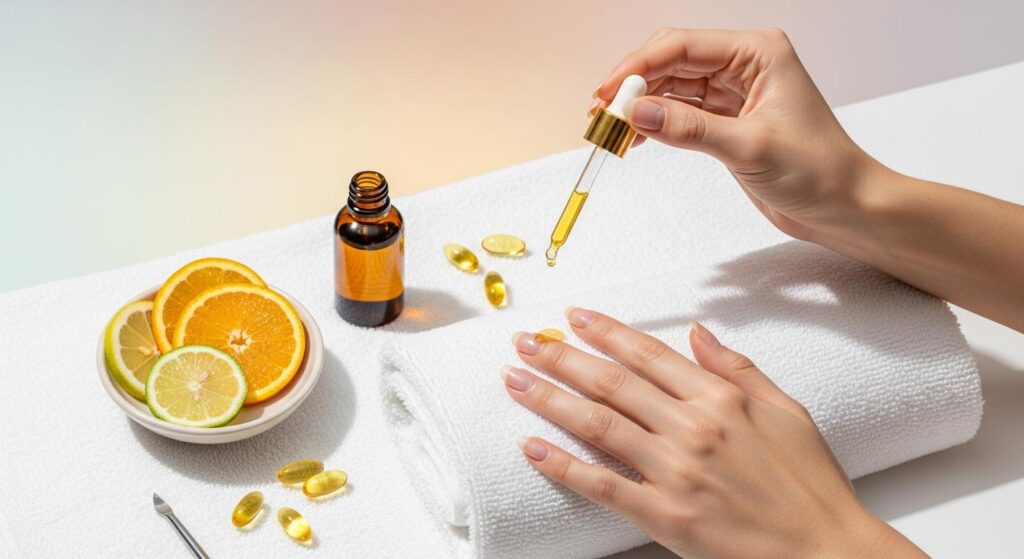
Hand cream alone often stops at the knuckles. Nails need care too. Cuticle oil softens the cuticle, supports healthy nail growth, and helps seal moisture into the nail plate.
Barrier-supporting ingredients like glycerin, ceramides, and plant oils protect nails from daily stress. Oils work best on slightly damp skin. Creams lock everything in.
A simple nighttime habit—massaging cuticle oil into bare nails before bed—can improve healthier nails within weeks. Small routines add up.
How Nail Shape, Length, and Filing Technique Matter
Nail shape influences strength. Rounded or softly squared shapes distribute stress evenly. Sharp corners create weak points where nail splitting begins.
Filing direction matters more than most people realize. Sawing back and forth weakens the nail surface. A gentle, one-direction file protects nail thickness.
Keeping natural nails slightly shorter during recovery reduces daily impact. Stronger nails grow when they aren’t fighting constant trauma.
Seasonal and Lifestyle Factors That Affect Nail Strength
Cold weather and low humidity pull moisture from skin and nails. Travel, climate changes, and long flights often lead to dry nails within days.
Hormonal shifts can influence nail texture and growth speed. Stress affects growth cycles as well. Aging brings natural changes in nail resilience, not failure, just evolution.
Understanding these patterns helps remove frustration. Nail fragility is often temporary.
Building a Nail-Strengthening Routine That Actually Works
Strong nails are built slowly. Healthy nail growth moves at about three millimeters per month. Visible improvement usually appears after several weeks of consistent nail care.
A routine that supports stronger nails often includes:
– Gentle manicure habits with proper filing
– Occasional breaks from gel manicure or acrylic nails
– Cuticle oil applied daily
– Gloves for cleaning and dishwashing
– Minimal exposure to acetone and harsh nail polish remover
Consistency matters more than product overload. When nail health improves, polish wears better, manicures last longer, and nail strength follows naturally.
Signs of progress include less peeling, smoother nail surface, improved flexibility, and fewer breaks. Healthy nails don’t need to be perfect. They just need support.
If your nails that break easily have been testing your patience, take heart. In most cases, a few thoughtful changes lead to healthier nails, stronger nails, and hands that feel cared for again. And that moment, when a nail finally grows past the fingertip without snapping, feels quietly triumphant.